Rental Deposit and End of Tenancy Statistics Ireland 2026: Rents, Disputes and Refunds
Last updated: September 2026. Human compiled and fact checked against each named source.
A rental deposit in Ireland is now a four figure sum in most of the country, and disagreements about getting it back have become one of the most common disputes the State handles. This page gathers the key Irish figures on deposits and the end of a tenancy in one place: what a deposit is worth, how many renters there are, how often deposits are fought over, and how those disputes end. Every figure links to its primary source, and anything we derived ourselves is labelled as calculated. Journalists, researchers and renters are welcome to cite any statistic here with a link back to this page as the reference.
Key Rental Deposit Statistics for Ireland at a Glance
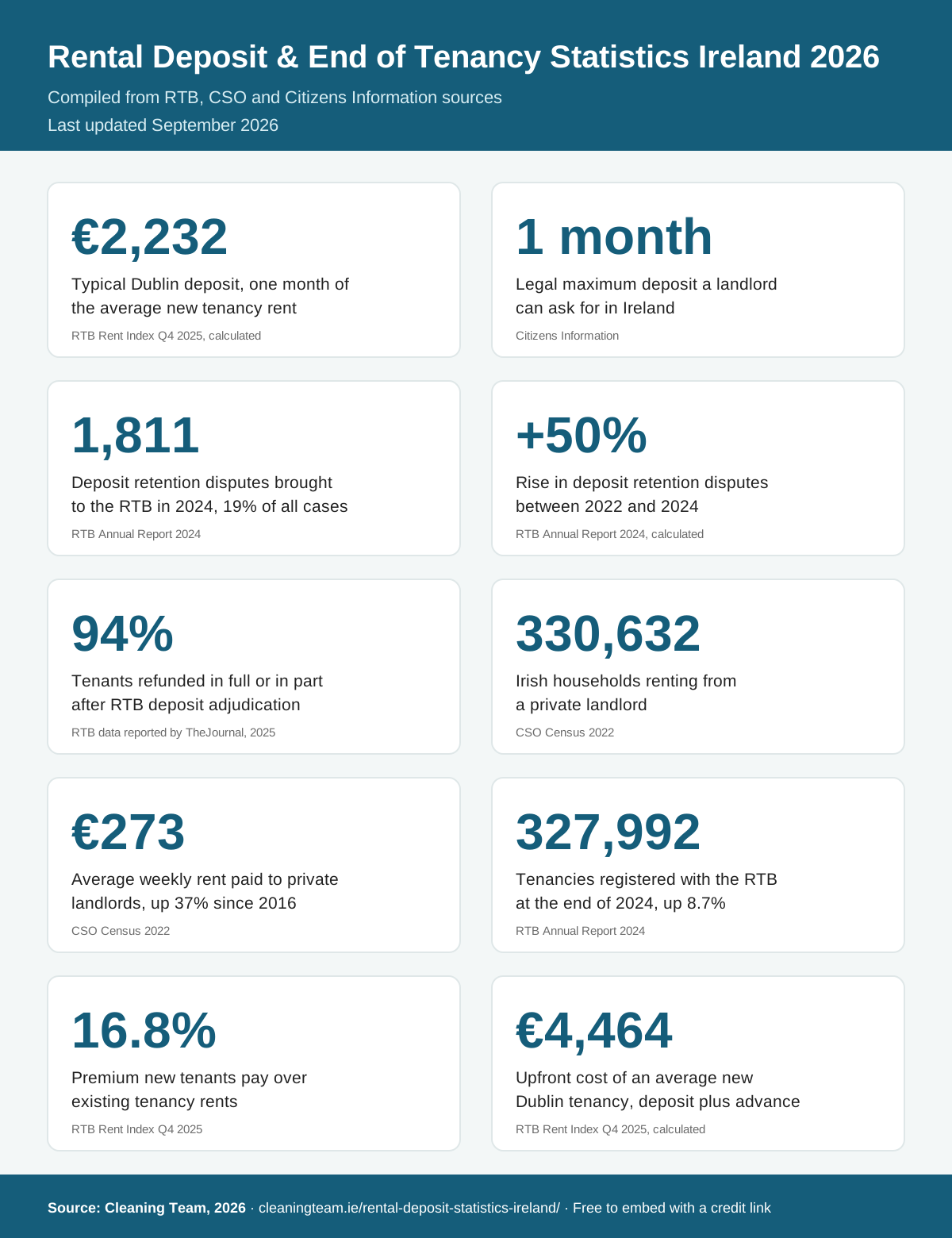
- The standardised average rent in new Dublin tenancies is €2,232 per month, which is also the legal maximum deposit for one of them. Source: RTB Rent Index Q4 2025
- A landlord cannot ask for more than two months' rent upfront: one month as a deposit and one month's rent in advance. Source: Citizens Information
- Deposit retention was the second most common reason for a dispute at the RTB in 2024, with 1,811 applications, or 19% of cases. Source: RTB Annual Report 2024
- Deposit retention disputes rose 50% in two years, from 1,207 in 2022 to 1,811 in 2024, calculated from the same RTB table. Source: RTB Annual Report 2024
- 94% of tenants whose deposit dispute went through RTB adjudication between 2019 and 2025 got a full or partial refund. Source: RTB data reported by TheJournal, September 2025
- 330,632 Irish households rent from a private landlord, up 7% since 2016. Source: CSO Census 2022, Profile 2 Housing
- The average rent paid to a private landlord was €273 per week at Census 2022, up 37% from €200 in 2016. Source: CSO Census 2022
- There were 327,992 tenancies registered with the RTB at the end of 2024, up 8.7% in a year. Source: RTB Annual Report 2024
- New tenancy rents are 16.8% higher than what existing tenants pay, which is what a renter faces when they move. Source: RTB Rent Index Q4 2025
- The deposit protection scheme signed into law in 2015 has never been commenced, so deposits are still held by landlords. Source: TheJournal, September 2025
What a Rental Deposit Is Worth in Ireland
Irish law caps the total upfront payment at the start of a tenancy at the equivalent of two months' rent: a deposit of no more than one month's rent, plus no more than one month's rent in advance, according to Citizens Information. That makes the typical deposit exactly one month's rent, so deposit sizes track the rent index directly. The table below is calculated on that basis from the standardised average rents for new tenancies in the RTB Rent Index Q4 2025.
| Location | Average new tenancy rent, Q4 2025 | Typical deposit (one month, calculated) |
|---|---|---|
| National | €1,755 | €1,755 |
| Dublin (county) | €2,232 | €2,232 |
| Dublin City | €2,191 | €2,191 |
| Galway City | €1,834 | €1,834 |
| Limerick City | €1,814 | €1,814 |
| Cork City | €1,756 | €1,756 |
| Waterford City | €1,317 | €1,317 |
| Stillorgan LEA, highest in the State | €2,867 | €2,867 |
| Lifford-Stranorlar LEA, lowest published | €933 | €933 |
The cap also defines the full upfront cost of moving. A landlord can ask for at most one month's deposit plus one month's rent in advance, so a renter taking an average new Dublin tenancy needs up to €4,464 before they get the keys, and €3,510 for the national average, calculated as two months of the RTB Q4 2025 new tenancy rents above. For most households that is the largest single cash outlay of the year, and the deposit half of it is the only part they can get back.
Moving itself carries a premium. In Q4 2025 the standardised average new tenancy rent of €1,755 was 16.8% higher than the €1,503 paid by existing tenants, according to the RTB Rent Index Q4 2025. A renter who loses part of a deposit is usually also paying more for the next property at the same time, which is why the final inspection matters so much.
How Rents and Deposits Have Moved
Because the deposit is pegged to one month's rent, every rent increase is also a deposit increase for the next tenant. The national standardised average rent for new tenancies stood at €1,755 per month in Q4 2025, an increase of €84 on the €1,671 recorded in Q4 2024, which is annual growth of 5.0%, according to the RTB Rent Index Q4 2025. Rents for existing tenancies grew 4.4% over the same year. Put another way, the typical deposit a renter needs to assemble rose by about €84 in a single year, calculated from the same index.
Growth is not evenly spread. Year on year inflation in new tenancy rents was 3.4% in Dublin and 2.9% in the rest of the Greater Dublin Area, but 6.9% outside the GDA, so deposits are rising fastest in the counties that start from lower rents. The gap between the dearest and cheapest markets remains wide: the highest standardised average new tenancy rent by local electoral area was €2,867 in Stillorgan in Dublin, while the lowest published figure was €933 in Lifford-Stranorlar in Donegal, and Leitrim was the lowest county at €1,006. For a family home the stakes are higher again: the average new tenancy rent for a three bedroom house was €1,778 nationally and €2,475 in Dublin in Q4 2025.
Ireland's Rental Market in Numbers
The scale of the deposit question is set by the size of the rental sector. At Census 2022, 330,632 households rented their home from a private landlord, a 7% increase on 2016, and the average rent they paid was €273 per week, up 37% from €200 in 2016, according to the CSO Census 2022 Profile 2, Housing in Ireland. Over 52,000 households were paying €400 or more per week to a private landlord, compared with 13,232 in 2016.
The register kept by the Residential Tenancies Board tells the same story from the regulator's side. There were 327,992 tenancies registered with the RTB at the end of 2024, an increase of 26,181 or 8.7% in a year, of which 240,964 were private tenancies, according to the RTB Annual Report 2024. The ownership profile is shifting: landlords with 100 or more tenancies accounted for 13.11% of private tenancies nationally at the end of 2024, and 26% in Dublin, against just 3.1% outside Dublin. In Q4 2025 alone, 11,593 new tenancies were registered and included in the rent index sample, and each of those new tenancies began with a deposit changing hands.
The non-private segments of the register are growing faster still. Approved Housing Body tenancies passed 50,000 for the first time in 2024, reaching 50,507, up 14.5% in a year, while registered cost rental tenancies grew 185% from a low base to 2,414, and student specific accommodation accounted for a further 36,521 tenancies, all per the RTB Annual Report 2024. Deposits, inspections and end of tenancy standards apply across all of these tenancy types, so the population of people with a deposit at stake keeps widening.
Deposit Disputes at the RTB
The RTB received 9,564 dispute applications in 2024, and deposit retention was the second most common reason for bringing one, named in 1,811 applications or 19% of cases, behind only rent arrears and overholding at 27%, according to the RTB Annual Report 2024. The trend is firmly upwards: deposit retention cases rose from 1,207 in 2022 to 1,606 in 2023 and 1,811 in 2024, an increase of 50% in two years, calculated from Table 10 of the same report.
Taking a case is deliberately cheap relative to what is at stake. RTB mediation is free, adjudication costs €30, and the board held 5,290 adjudication and mediation hearings in 2024. Set against a typical Dublin deposit of €2,232, the €30 adjudication fee is about 1.3% of the amount in dispute, calculated from the two figures above. Disputes over the standard and maintenance of a dwelling, the category where cleaning arguments land, were named in 1,115 applications or 12% of cases in 2024.
Do Tenants Get Their Deposits Back
When deposit disputes reach a formal decision, tenants usually recover money. 94% of tenants whose deposit dispute went through RTB adjudication between 2019 and 2025 received a full or partial refund, according to RTB adjudication data reported by TheJournal in September 2025. The same reporting found that the RTB logged over 1,800 deposit related requests in 2024, a 65% increase on 2021, and that the housing charity Threshold was fielding an average of three deposit queries a day during 2025.
Ireland still has no deposit protection scheme in operation. Legislation passed in 2015 that would have required deposits to be lodged with the RTB has never been commenced, and in September 2025 the Minister for Housing said the Housing Agency's examination of a deposit holding system was still under consideration, as reported by TheJournal. Until that changes, the deposit sits with the landlord, and the condition of the property at handover decides whether it comes back.
The grounds on which a landlord can lawfully keep some or all of a deposit are narrow. Deductions are allowed for unpaid rent, for damage beyond normal wear and tear, and for outstanding bills or charges the tenant was liable for, according to Citizens Information. Cleanliness sits inside the wear and tear argument, which is why photographs, a checklist and a dated receipt for a professional clean are the evidence that settles most handover conversations before they become one of the 1,811 cases above.
Cleaning and the Final Inspection
Cleaning is the part of a move-out a tenant can actually control. Disputes about the standard of a dwelling made up 12% of RTB cases in 2024, and a documented professional clean removes cleanliness from the argument entirely. The cost side is modest against the sums above: the statutory minimum pay for a contract cleaner is €14.80 per hour in 2026, and household cleaning product prices actually fell 2.3% in the year to July 2026, figures we track with full sources on our cleaning and housework statistics for Ireland page. A few hours of professional cleaning is a small hedge on a €2,232 deposit.
An end of tenancy clean is also a different job from a regular or deep clean: it works to the letting agent's inspection sheet rather than the occupant's comfort, covering ovens, limescale, windows and the inside of every fitted unit. Our guide to end of tenancy versus deep cleaning explains the difference, and tenants moving at the busy times of year should note that professional cleaners book out fastest around the start of September, exactly when most tenancies turn over.
Method and Sources
Every statistic on this page was verified against its named source on 7 September 2026. The sources are the RTB Rent Index Q4 2025 and RTB Annual Report and Accounts 2024 for rents, registrations and dispute figures, the CSO Census of Population 2022 Profile 2 for the size of the rental sector and rents paid, Citizens Information for the legal limits on deposits and advance rent, and RTB data reported by TheJournal in September 2025 for adjudication refund outcomes and the status of the deposit protection scheme. Calculated figures are labelled in the text: the typical deposit table applies the one month convention to RTB standardised average rents, the 50% rise in deposit disputes is derived from Table 10 of the RTB Annual Report, and the adjudication fee comparison divides €30 by the Dublin average deposit. This page will be refreshed when the RTB publishes each quarterly Rent Index and its 2025 Annual Report.
How Cleaning Team Helps
Cleaning Team provides professional end of tenancy cleaning across Dublin, Kildare, Meath and Wicklow, working to the standard letting agents inspect against. Our end of tenancy checklist shows exactly what is covered, and a dated invoice from a professional clean is useful evidence if a deposit conversation ever turns into a dispute. Contact us for a quote or book online in a few minutes.